Start my assessment

IT and business service management: ITSM and ESM that people actually use.

We help organisations design, implement and improve their service management processes, for the IT department and for business functions alike. Service catalogues, portals and other contact channels, service commitments, knowledge base, workflows, automation and reporting: we work on the whole system with one simple aim, that it be understood, used and genuinely applied by the teams.

Atlassian Platinum Solution Partner, ITSM specialisation · Certified Matrix42 experts · Paris and Lyon, since 2008

ITSM and ESM: organising services, not just tickets.

Most organisations already have tools to handle requests. Raising a ticket is rarely the problem.

The difficulties lie elsewhere: a catalogue that is hard to read, several contact channels running in parallel, requests landing in the wrong place, service commitments no one can interpret, knowledge scattered across the organisation, or workflows that no longer match how teams actually work.

Our role is to work on the entire service chain:

01
The service catalogue

What the IT department provides, to whom, on what terms.

02
Portals and other contact channels

A single point of contact, whatever the channel.

03
Incidents and requests

Qualification, assignment, resolution.

04
Changes and problems

What stops the same outage happening twice.

05
CMDB and assets

Configuration items and their dependencies.

06
SLAs and SLOs

Time and quality, with the method used to calculate them.

07
Workflows and automation

Standardised processes that run smoothly.

08
Roles and responsibilities

Secure control over the process.

09
Straightforward indicators

Decisions that are easy to make and act on.

ITSM and ITIL are not the same thing

ITSM is the discipline; ITIL is its most widely used best-practice framework, in its ITIL 4 version. Our position: ITIL provides a shared vocabulary and guard rails, not a deployment plan.

An organisation-wide approach

This approach applies to the IT department through ITSM, but equally to support functions across the business through ESM: human resources, procurement, facilities, finance, or any team providing services to internal users.

Our five-stage method applied to ITSM and ESM.

BleuLemon, a French consultancy (Paris, Lyon) and Atlassian Platinum Solution Partner since 2008, applies the same five-stage framework.

01
Understand

We start from your reality: the processes actually followed, the requests received, the channels used, what irritates teams and users, the tools in place and the service levels genuinely observed. The first stage is to understand how the service works today, not only how it is meant to work.

02
Scope

We define the target model with you: services offered, populations concerned, access channels, responsibilities, workflows, service commitments and management indicators. We also prioritise what must be dealt with immediately and what can evolve later.

03
Deploy

We configure and integrate processes and tools step by step: catalogues, portals, workflows, automation, knowledge base, dashboards and interfaces with the rest of the information system. We favour progressive releases over a single switchover.

04
Drive adoption

Adoption is prepared from the earliest stages of the project. At deployment, the effort intensifies: communication, training, support for the teams, documentation and dealing with irritants. Agents, managers and users do not experience change in the same way: we adapt the support to each population.

05
Keep it alive

A service management platform has to evolve with the organisation. We measure usage and service levels, develop the catalogues and workflows, enrich the knowledge base and prepare, where it makes sense, the extension to new services or new populations.

Tooling in the service of the process.

We work mainly with Jira Service Management and Matrix42, two ecosystems that suit different contexts. We do not choose a platform before we have understood the processes, the hosting constraints, the ways of working and the goals of the project.

Atlassian

Jira Service Management integrates naturally with Jira and Confluence. It is particularly relevant when IT, development and support teams already work within the Atlassian ecosystem, or when the organisation wants a shared foundation across several service functions. Its ecosystem and extensibility also make it possible to address ESM needs beyond the IT department.

Matrix42

Matrix42 offers a tightly integrated approach to service and asset management, with several hosting options. It can suit contexts where sovereignty, ITAM or control over the hosting environment carry particular weight.

No tool rules itself out on principle. The choice depends on the context, the processes, what is already in place and the organisation's priorities.

The right solution is not the one we would rather implement, but the one that lastingly finds its place in your organisation.
BleuLemon, what we believe
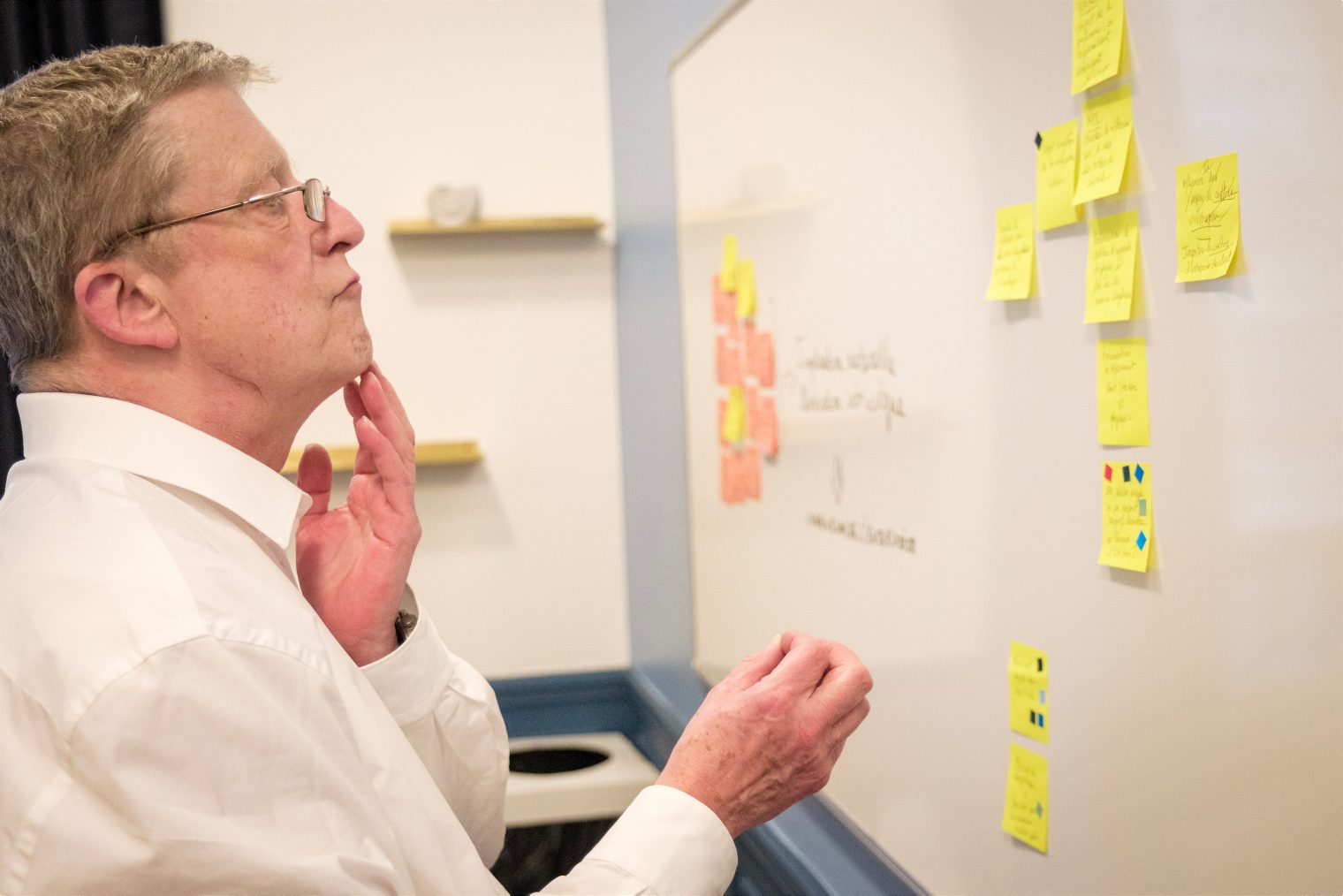
Scoping a service catalogue on a wall of sticky notes

From ITSM to ESM.

The principles that let an IT department structure its services can be applied to the other functions of the business.

An employee requesting a laptop, an HR certificate, a badge, a procurement service or a facilities intervention ultimately faces the same question: how do I reach the right service easily, and follow my request?

ESM extends service management practices beyond IT. It makes it possible to offer shared portals, clarify commitments, automate workflows and share knowledge across support functions.

This is not about mechanically transposing IT processes onto business teams. Each service keeps its own rules, its own vocabulary and its own constraints. We apply ITSM principles where they add value, and adapt them to each context.

What we measure.

Key indicatorWhat it lets you observe
Incident MTTRThe average time needed to restore the service
Portal FCRThe ability to resolve a request at first contact
Support CSATUser satisfaction once the request has been handled
SLA/SLO complianceThe ability to meet service commitments
Ageing backlogThe ability to avoid a build-up of unhandled requests
Knowledge capitalisationThe ability of the team and of users to reuse existing answers
Share of requests coming through the portalAdoption of the intended contact channels

Examples drawn from past engagements, to be redefined with you according to your context and your current priorities, never a market standard.

Opteven replaces GLPI with Jira Service Management.

Service desk floor: headset-wearing agents at their portal screens
ITSM redesign & migration

ITSM redesign and migration to Jira Service Management and Assets

First release after 7 weeks, full production in under 4 months, catalogue simplified to 5 levels. The scoping plan covered 117 days; consumption stayed within the envelope. An application maintenance contract followed.

7 wksfrom takeover to first release
500tickets taken over with no service interruption
5 levelsof catalogue, replacing an unreadable tree
Read the case study

The questions we get asked about ITSM

A question that finds no answer here is dealt with in a thirty-minute conversation, about your actual context rather than a general case.

Talk to an expert
What is the difference between ITSM and ESM (Enterprise Service Management)?

ITSM organises the delivery of IT services: requests, incidents, changes, service levels, knowledge and the service catalogue. ESM applies the same service management principles to the other functions of the business: human resources, procurement, facilities, finance or any other internal service. Both rest on a shared logic, but the processes and the vocabulary adapt to each line of work.

How do you choose an ITSM tool?

Three criteria settle it: your existing technical estate, your data location constraints, and the administration workload your teams are willing to carry. The choice of ITSM software comes after the catalogue and the commitments have been scoped, otherwise the tool inherits the existing disorder.

Do you already need an ITSM tool to work with BleuLemon?

No. We can work on an existing setup, develop a platform already in place, or support the choice and deployment of a new solution. We start with the processes, the ways of working and the goals. The tool comes afterwards.

Why call on BleuLemon rather than the vendor, or run the project in-house?

Because our work does not stop at configuring the platform. We treat processes, organisation, tooling and adoption as one coherent whole. We can work alongside your internal teams and the vendors, bringing our experience of ITSM and ESM projects and our ability to connect ways of working, processes and technology.

What is a CMDB and what is it for?

A CMDB (Configuration Management Database) records the configuration items of the information system, servers, applications, workstations, contracts, and above all their dependencies. Its real value: measuring the impact of an incident or a change before acting. We keep its scope to the uses agreed during scoping.

What is an IT SLA and how do you define one?

An IT SLA is a commitment on time and quality for a service, with its calculation method and its exclusions. It is defined from your own historical data, not from an external benchmark. Without automated measurement in the tool, an SLA remains a statement of intent.

How long does an ITSM deployment project take?

The duration depends on the scope, the number of services involved, what is already in place and the populations to support. We aim as far as possible for a first release within 90 days. A project that goes too long without a concrete result loses momentum, occupies teams with nothing visible to show, and becomes harder to get adopted.

Where the scope is broader, we therefore prefer to deliver a first working version, measure how it is used and improve it in a second version, rather than trying to cover everything in the first deployment. Delivering quickly is what lets you learn about real usage and stay effective.

Are you ITIL certified?

Yes. Our consultants are certified in ITIL v3 and ITIL 4. We use ITIL as a best-practice framework and a shared vocabulary, not as a recipe to be applied as is. Processes have to stay suited to your organisation, your users and your constraints.

What role does AI play in IT service management?

AI can come in at several levels: helping the user phrase a request, searching the knowledge base for an answer, suggesting a qualification, summarising a history or spotting recurring requests. Its role depends on the process and on how much autonomy the organisation wants to give it. From the scoping stage we define what can be automated, what needs human validation and what must stay in the hands of the teams.


Going further: our services · The Assessment · Jira training